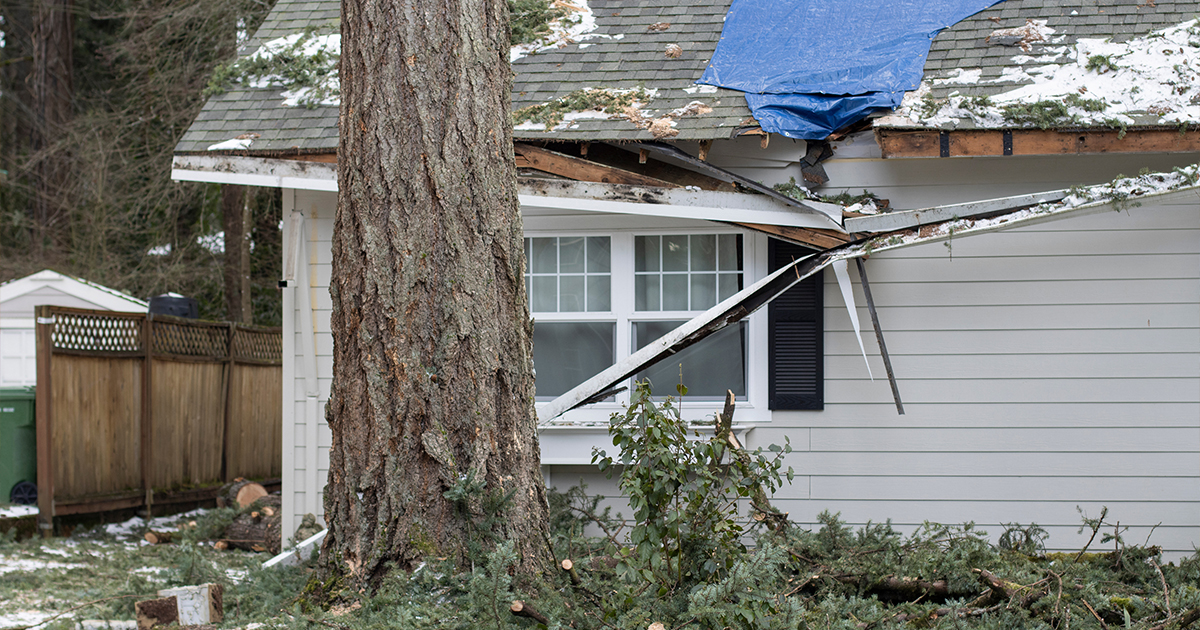
Every year, storms knock trees onto cars, houses, fences and people, all over the Hudson Valley. In the aftermath, the same question always surfaces: whose fault is this? If your neighbor’s oak lands on your garage, do they owe you a new roof? If a roadside tree hits your car, can you sue whoever owns the land?
The internet is full of vague answers. But New York’s courts have ruled on this exact question many times, including in cases from right here in the Hudson Valley. The decisions are public record, and the rule they lay out is clear: it has a direct lesson for every property owner with big trees.
We’re a tree company, not a law firm, and nothing here is legal advice. But we’ve read the decisions, and here’s what they say.
The Rule: It Comes Down to “Notice”
New York’s highest court set the standard in Ivancic v Olmstead (1985), a case about a limb that fell from a neighbor’s maple in Montgomery County, NY. A property owner is liable for a falling tree only if they had actual or constructive notice that the tree was dangerous, meaning they either knew about the hazard, or the signs of decay were so readily observable that they should have known.
Just as important is what the court said landowners are not required to do:
“There is no duty to consistently and constantly check all trees for nonvisible decay. Rather, the manifestation of said decay must be readily observable in order to require a landowner to take reasonable steps to prevent harm.”
In plain terms: if a healthy-looking tree fails with no warning, that’s generally nobody’s fault in the eyes of the law. But if the tree was visibly dead, rotted, cracked, fungus-ridden, or leaning, and the owner did nothing, then that’s a different story.
Everything in a falling-tree case turns on that one question: was there something visible that should have prompted action?
A Tree Falls on Route 28: Whalen v. NYC Department of Environmental Protection
In a case that will sound familiar to anyone who drives the Route 28 corridor between Kingston and the Catskills: a driver was injured when a tree fell onto his moving car on State Route 28 in Ulster County. The land beside the road was New York City reservoir property, part of the vast watershed acreage the City owns across Ulster and Greene counties around the Ashokan.
The driver sued, alleging the City had failed to remove a “diseased, decaying, and unstable” tree from the edge of the roadway. The City tried to get the case thrown out, arguing among other things that a 1947 easement made the roadside strip the State’s responsibility, not the City’s.
The appeals court didn’t buy it. In 2011, it reinstated the lawsuit, ruling that the City hadn’t shown the easement absolved it of responsibility for trees on its own land (Whalen v New York City Dept. of Envtl. Protection, 2011). To be precise about what that means: the court didn’t declare the City liable — it ruled the case had to proceed, because the question of whether the City should have noticed and removed the decaying tree deserved a full airing.
The takeaway for Hudson Valley property owners is bigger than one lawsuit: owning land near a road means owning the trees that can reach it — and “someone else maintains that strip” is not the automatic escape hatch people assume. That’s true whether the owner is New York City or a homeowner on a town road in Saugerties.
The Neighbor’s Willow: Weaver v. Metsker
The most instructive recent case comes from just up the Thruway in Albany, decided in October 2024 by the Appellate Division, Third Department — the same appeals court whose rulings govern Ulster, Greene, and Columbia counties.
A willow planted in 1960 had grown into a giant — taller than the house, six feet across at the trunk — with one large limb extending over the fence into the neighbors’ yard. In September 2020, that limb fell and seriously injured the neighbor standing beneath it. She sued the tree’s owner; the owner, in turn, pulled in two other parties after discovering the trunk actually extended onto land owned by the City of Albany and a county land bank.
Two things about the court’s 2024 ruling (Weaver v Metsker) matter for every homeowner with a big tree near a property line:
- Hiring a tree service did NOT count against the owner. The owner had previously brought in a tree company, which trimmed out dead and broken limbs and pruned the tree for storm resistance. The plaintiffs argued the maintenance invoice proved he knew the tree was dangerous. The court rejected that: routine professional maintenance is just that — routine. It is not an admission that a tree is a hazard. If anything, the completed service with no flagged concerns cut in the owner’s favor.
- What kept him in the lawsuit was his own observation. In his deposition, the owner acknowledged that years earlier someone had tried to cut the tree down and left it “mutilated,” and that the limb which later fell had grown back — in his words — “beautiful but weak.” That single admission, the court held, created a genuine question of whether he had notice the limb was dangerous. His request to have the case dismissed was denied.
Meanwhile, the City and the land bank — part-owners of the tree who had never observed any rot or decay — were let out of the contribution claims entirely. No visible signs, no notice, no liability.
What This Means If You Own Trees in the Hudson Valley
Put the cases together and the practical picture is remarkably consistent:
- You are not the insurer of every tree on your land. A hidden defect that no reasonable person would have spotted is not your legal problem.
- Visible warning signs change everything. Dead limbs, peeling bark, fungus at the base, cracks, a lean that wasn’t there last year — once decay is readily observable, the clock starts running on your duty to act.
- What you say you noticed matters. In Weaver, an offhand recollection that a limb was “weak” was enough to keep the owner in litigation for years. If you’ve noticed something about a tree, the answer is to deal with it, not to hope it holds.
- Professional maintenance protects you — in both directions. It keeps trees healthier and less likely to fail, and the Weaver court confirmed that bringing in professionals is treated as responsible ownership, not evidence of a known hazard.
- Near roads and property lines, take extra care. Both cases involved a tree reaching beyond its own parcel — over a highway, over a fence. That’s where falling trees stop being your problem and start being a dispute.
The Honest Conclusion
If there’s one sentence to remember from four decades of New York falling-tree decisions, it’s this: the law protects owners who couldn’t have known, and it has little patience for owners who saw the signs and did nothing.
Which means the smartest thing a Hudson Valley property owner can do — legally and practically — is make sure someone qualified actually looks at your big trees now and then, especially the ones near the house, the road, or the neighbor’s side of the fence. Catching a problem early usually means a trim or a cable instead of a removal, and it means you’re never the owner who “knew it was weak.”
We’ve been looking at Hudson Valley trees since 1936. If a tree on your property has been on your mind — leaning, dropping limbs, looking thin — call us at 845-331-6782 for tree trimming and maintenance, or fill out the estimate form. It’s free, and it’s a lot cheaper than finding out in court what “readily observable” means.