Tree Cabling & Bracing Services in the Hudson Valley
Schedule an Appointment:
845-331-6782
Not every problem tree needs to come down. Many of the large trees on Hudson Valley properties, such as sugar maples, red oaks, sycamores, beeches, are valuable trees that provide decades of shade, character, and property value. When these mature trees develop structural issues like co-dominant stems, heavy lateral limbs, or storm damage, tree cabling and tree bracing can extend the tree’s life for years or decades without removal.
Expert Tree Service provides tree cabling, tree bracing, and structural support systems for homeowners and property owners throughout the Hudson Valley, New York. We’ve been handling tree care and tree service in this region since 1936, and we know when a tree is worth saving, and when removal is the honest recommendation. We’ll assess your tree’s structure, explain your options, and give you a straight answer.
Call us at 845-331-6782 for a free risk assessment and estimate.
What Is Tree Cabling and Bracing?
Tree cabling and tree bracing are two complementary techniques used to provide additional support to trees with structural weaknesses. They reduce the risk of tree failure — limbs breaking off or the trunk splitting apart — without removing the tree. When installed correctly, cabling systems and bracing systems can keep a structurally compromised tree safe and standing for many more years.
Tree Cabling
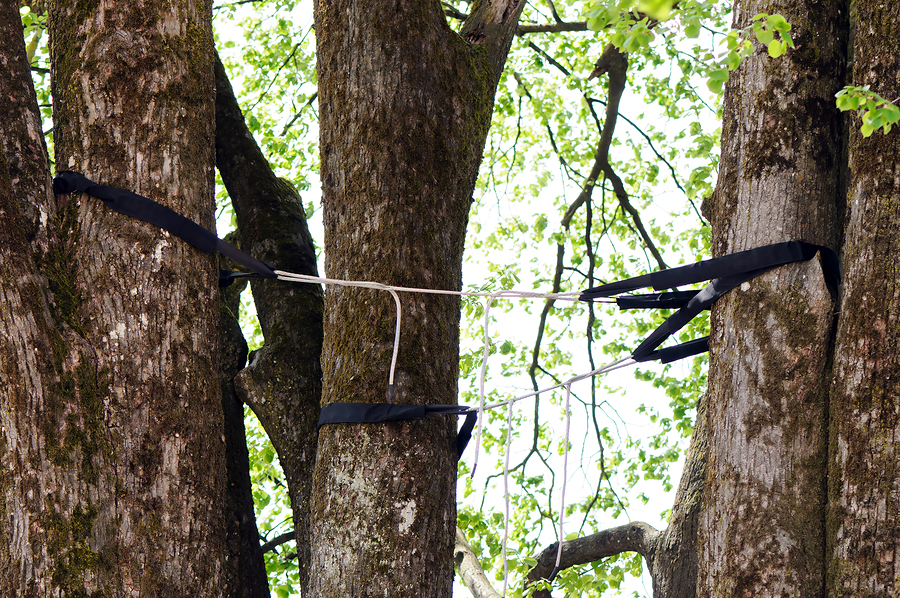
Tree cabling involves installing high-strength steel cable (or in some cases synthetic cable) between major limbs or stems high in the tree’s canopy. The cable limits how far the branches can move apart during wind, ice, or snow loading. It doesn’t hold the tree together by brute force — it reduces the range of motion so the weak point is never stressed beyond its capacity. Cabling systems are the most common form of tree support systems and are used primarily for trees with co-dominant stems, heavy lateral branches, or wide V-shaped crotches that are prone to splitting.
Tree Bracing
Tree bracing uses bracing rods — threaded steel rods installed directly through the trunk or through a weak branch union — to physically reinforce the tree’s structure from the inside. Bracing is used when the structural failure risk is at the trunk level: splits, cracks, included bark in a co-dominant stem union, or decay that has weakened a critical junction. Bracing rods provide rigid support that prevents the two sides of a split from moving apart. Bracing services are often combined with cabling for comprehensive structural support.
When They’re Used Together
Many trees benefit from both cabling and bracing installed as a combined system. A large maple with co-dominant stems and a visible crack at the union, for example, might get bracing rods through the union to prevent the split from widening, plus a steel cable higher in the canopy to reduce leverage on that union during storms. These combined tree support systems give the tree the best chance of surviving intact through the kind of wind, ice, and snow events that are common in the Hudson Valley.
When Does Your Tree Need Cabling or Bracing?
Not every tree with a flaw needs structural support, and not every flawed tree can be saved. Here are the most common situations where cabling or bracing makes sense:
Co-Dominant Stems
Co-dominant stems — two or more trunks of roughly equal size growing from the same point — are one of the most common structural issues in large trees. When the stems form a tight V-shape with included bark (bark trapped in the union rather than pushed out), the connection is weak and prone to splitting. This is extremely common in sugar maples, silver maples, and Bradford pears throughout the Hudson Valley. Cabling above the union and bracing through it can prevent the kind of catastrophic split that drops half a tree onto a house.
Heavy or Overextended Limbs
Some trees develop one or two limbs that grow disproportionately long or heavy. These become leverage points — the weight of the limb multiplied by its distance from the trunk creates enormous stress on the branch union. A weak branch like this is a prime candidate for failure during a storm or under snow load. Cabling provides additional support by connecting the heavy limb to a stronger one higher in the tree, redistributing the load so no single branch union bears all the stress.
Storm-Damaged Trees
Trees that have survived storm damage — lost a major limb, developed a crack in the trunk, or had their canopy rearranged by wind — often have new structural issues that didn’t exist before. If the remaining tree’s structure is sound and the tree is otherwise healthy, cabling and bracing can stabilize damaged trees and prevent secondary failures. This is a judgment call that depends on the extent of the damage and the tree’s overall health.
Mature Trees With Decay
As trees age, decay in the trunk or major branch unions is inevitable. The question is whether the remaining sound wood can still support the tree’s structure. In many cases, mature trees with moderate decay are structurally viable with the right support systems in place. Cabling reduces the dynamic loads on weakened areas, and bracing reinforces specific points where decay has reduced the tree’s structure below what it needs to hold. If the decay is too far advanced, we’ll tell you — sometimes removal is the only safe option.
Trees Near Structures
A tree leaning over your house, your garage, your driveway, or your kids’ play area carries higher stakes than one in the middle of an open field. When a valuable tree has a structural issue and it’s positioned where tree failure would cause property damage or a safety risk, cabling and bracing become a serious investment rather than an optional improvement. The cost of structural support is a fraction of the cost of a tree coming through a roof.
How We Assess and Install Tree Support Systems
Risk Assessment
Every cabling and bracing job starts with a thorough risk assessment. We inspect the tree from the ground and — when warranted — from up in the canopy. We’re looking at the tree’s structure from the root flare to the crown: trunk integrity, branch union strength, lean, canopy balance, signs of decay, and overall tree health. We also evaluate the target zone — what’s at risk if the tree or a part of the tree fails. This assessment drives our recommendation: cable, brace, prune, remove, or leave it alone.
System Design
Based on the assessment, we design the support system specific to your tree’s needs. There’s no one-size-fits-all approach to cabling and bracing. We determine cable placement height (typically two-thirds of the way between the weak point and the ends of the branches), cable type and strength rating, bracing rod diameter and placement, and whether the tree also needs tree pruning to reduce weight or improve balance. Every component is matched to the tree’s size, the loads it experiences, and the specific structural issues we’re addressing.
Installation
Our crew installs the cabling systems and bracing systems using industry-standard hardware and techniques. Steel cable is attached using through-bolts or eye bolts drilled into the wood — the hardware is sized to the tree and the anticipated loads. Bracing rods are drilled through the union or trunk, secured with washers and nuts on each side. The work is done by climbers in the tree, not from a bucket truck, because precise placement matters. Installation typically takes a few hours for a single tree.
Follow-Up Inspection
Cabling and bracing systems aren’t install-and-forget. Hardware can shift as the tree grows. Cables stretch under repeated loading. New decay can develop around bolt holes. We recommend inspecting support systems every 2 to 3 years to make sure everything is still performing as designed. We’ll also recommend tree pruning as part of ongoing tree care to keep the canopy balanced and reduce the loads on the support system.
When to Cable and Brace vs. When to Remove
We get this question a lot, and the honest answer is: it depends on the tree. Here’s how we think about it:
Cabling and bracing make sense when the tree is otherwise healthy, the structural issues are specific and addressable, the tree has significant value (shade, character, property value, ecological function), and the cost of support is reasonable relative to the tree’s remaining life expectancy.
Removal is the better call when decay is widespread and the tree’s structure is fundamentally compromised, when multiple structural failures are likely regardless of support, when the tree is already dead or dying from disease or insect damage, or when the cost of ongoing support exceeds the tree’s practical value.
We’ll always give you an honest recommendation. We don’t push cabling on trees that should come down, and we don’t push removal on valuable trees that can be saved. If the tree’s needs point to structural support, we’ll explain exactly what’s involved and what it costs. If the tree needs to come down, we provide tree removal services and stump grinding as well.
Related Tree Care Services
Cabling and bracing are part of a broader approach to preserving and maintaining your trees. We also provide:
- Tree pruning — Crown thinning, deadwood removal, and structural pruning to complement cabling and bracing systems and reduce wind and ice loading
- Deep-root fertilization — Improves tree health and vigor, especially for stressed or damaged trees recovering from structural work
- Tree removal — When a tree can’t be saved, we handle safe removal including crane-assisted removal for hazardous trees near structures
- Stump grinding — Complete stump removal after any tree comes down
- Storm damage response — 24/7 emergency service for storm damage, including emergency cabling for partially-failed trees
Frequently Asked Questions
Pricing depends on the size of the tree, the number of cables and bracing rods needed, and the complexity of the installation. A single cable in a moderate-sized tree is on the lower end; a large tree with multiple co-dominant stems requiring cables and bracing rods will cost more. We provide free on-site estimates with written pricing — no surprises.
Properly installed cabling and bracing can last 15 to 25 years or more. Steel cable is durable and weather-resistant, and bracing rods are permanent once installed. The limiting factor is usually the tree itself — as it grows, hardware may need adjustment, and new structural issues can develop. Regular inspection every 2 to 3 years keeps the system performing and catches any changes early.
The hardware does create small wounds where bolts penetrate the wood, but healthy trees compartmentalize these wounds quickly. The minor damage from installation is far less than the catastrophic damage that would result from structural failure without support. Modern installation techniques minimize wound size and place hardware in locations where the tree can grow around it naturally.
In many cases, yes — if the crack hasn’t progressed too far and the wood around it is still sound. Bracing rods installed through the split hold the two sides together, and cables above reduce the forces that caused the split in the first place. If the split is too advanced or decay is present in the union, removal may be the safer option. A risk assessment will tell us which approach is appropriate.
Yes. If we assess a tree and determine that cabling and bracing won’t adequately address the structural failure risk, we’ll recommend removal and provide a quote. We offer full tree removal services including crane-assisted removal for large trees and hazardous trees near structures. We’d rather give you an honest answer than install support on a tree that’s going to fail anyway.
We provide tree cabling, bracing services, and complete tree care throughout the Hudson Valley, New York — including Ulster County, Dutchess County, Greene County, and Columbia County. Call us at 845-331-6782 to schedule a free risk assessment.
Service Areas
Expert Tree Service provides tree cabling, tree bracing, tree pruning, and complete tree care throughout the Hudson Valley, New York. We serve homeowners and property owners in:
Kingston | Saugerties | Rhinebeck | Red Hook | Poughkeepsie | New Paltz | Catskill | Pawling | Ellenville | Woodstock | Hyde Park
Get a Free Tree Assessment
Worried about a tree on your property? Not sure whether it needs support, pruning, or removal? Call 845-331-6782 or fill out the form below. We’ll assess the tree’s structure, explain your options, and give you a written estimate. No pressure, no upselling — just an honest evaluation of your tree’s needs from a tree service with nearly 90 years of experience in the Hudson Valley.
Recent Posts
- Tree Removal in Ulster County, NY: What Every Homeowner Should Know
 Ulster County is our home. Expert Tree Service has been based in Saugerties since 1936,...
 - Tree Removal in Columbia County, NY: What Every Homeowner Should Know
 Columbia County sits just across the Hudson from our Saugerties headquarters, and we’ve been working...
 - When a Tree Falls in the Hudson Valley, Who Pays? What New York Courts Have Actually Ruled
 Every year, storms knock trees onto cars, houses, fences and people, all over the Hudson...