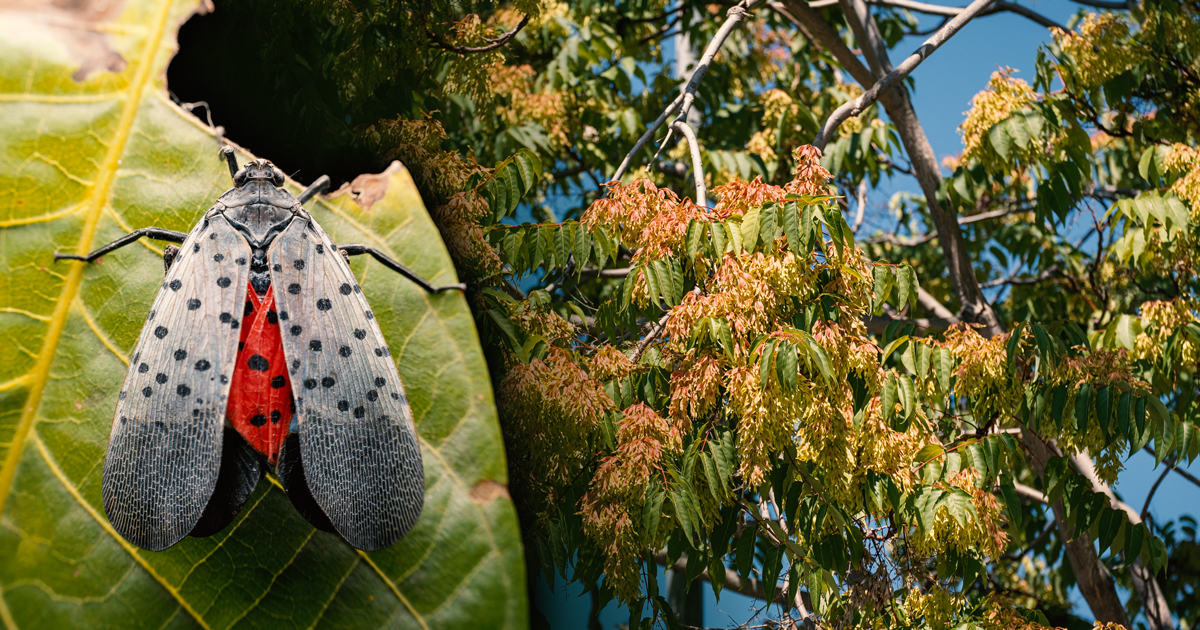
The trees across Ulster, Dutchess, Greene, and Columbia counties are under siege from insects and plants that didn’t exist here a generation ago. Emerald ash borers have killed virtually every ash tree in some towns. Hemlock woolly adelgid is working through our hemlock groves. Spongy moths (formerly gypsy moths) defoliate thousands of acres in bad years. And the spotted lanternfly is expanding into our region, drawn by the invasive ailanthus trees already growing on many properties.
As a tree service company that’s been working in the Hudson Valley since 1936, we’ve watched these threats arrive one by one and accelerate. This guide covers the major invasive pests and plants affecting our area, how to spot them, and what you can do to protect your trees, or know when it’s time to call for professional help.
Emerald Ash Borer: The Pest That Wiped Out Our Ash Trees
The emerald ash borer (Agrilus planipennis) is a small, metallic-green beetle that has devastated ash tree populations throughout the Northeast since arriving from Asia around 2002. It reached the Hudson Valley around 2010, and in many of our communities the damage has been catastrophic.
The beetle’s larvae bore beneath the bark and feed on the tissue that transports water and nutrients, effectively cutting off the tree’s circulatory system. A healthy ash can go from fine to dead in just two to three years after infestation.
Local Ash Tree Mortality Rates
According to monitoring data from the Ecological Research Institute, the ash borer has caused staggering losses across our region:
| Town | Ash Tree Mortality Rate |
| Kingston | 95% |
| Saugerties | 83% |
| New Paltz | 77% |
| Poughkeepsie | 78% |
| Rhinebeck | 89% |
| Red Hook | 64% |
| Highland | 98% |
| Stone Ridge | 100% |
| West Hurley | 100% |
| Shokan | 98% |
These numbers tell the story: in many Hudson Valley communities, the ash borer has killed nearly every ash tree. The result is thousands of dead or dying standing trees that pose falling hazards to homes, vehicles, and people below.
How to Spot an Ash Borer Infestation
- D-shaped exit holes in the bark (about 1/8 inch wide)—the signature sign
- Canopy thinning starting at the top of the tree
- Bark splitting with S-shaped tunnels visible beneath
- Increased woodpecker activity (they feed on the larvae)
- Epicormic sprouting—new shoots growing from the trunk as the tree tries to survive
What to Do
If you have ash trees and you’re in one of the high-mortality zones listed above, get them inspected soon. A certified arborist may be able to treat early-stage infestations with insecticide injections, but if the canopy has already thinned significantly, removal is likely necessary. Dead ash trees become brittle quickly and are extremely dangerous to take down without professional equipment.
Hemlock Woolly Adelgid: A Slow-Motion Threat to Our Hemlocks
The hemlock woolly adelgid (Adelges tsugae) is an aphid-like insect that feeds on the sap of hemlock trees. Unlike the ash borer’s rapid kill, the adelgid works more slowly, but just as lethally over time. It’s been confirmed throughout Dutchess, Ulster, and Greene counties, with over 200 reports in the iMapInvasives database.
How It Works
Adelgids attach at the base of hemlock needles and feed on stored starches. The tree gradually weakens, losing needles, producing less new growth, and becoming vulnerable to drought and other stresses. Without intervention, an infested hemlock can decline over three to ten years.
How to Identify It
Look for small white, cottony masses (about the size of a cotton swab tip) clustered at the base of needles on the underside of branches. They’re most visible in late fall through spring. If your hemlock has thin, grayish foliage with visible dieback at the branch tips, adelgid may be the cause.
Treatment Options
Unlike the ash borer situation, adelgid-infested hemlocks can often be saved if caught early. Systemic insecticide treatments (soil drenches or trunk injections) can be effective, and biological control agents are being studied and released in some areas. However, severely weakened hemlocks near structures should be evaluated for removal, as they become increasingly brittle and prone to failure in wind events.
Elongate Hemlock Scale: The Double Threat
Working alongside the woolly adelgid in many areas is the elongate hemlock scale (Fiorinia externa), an armored scale insect that attacks hemlock needles. It has been reported primarily in western Ulster County (50 confirmed reports), and when combined with adelgid infestation, it accelerates hemlock decline dramatically.
The scale feeds on needle tissue, causing yellowing, needle drop, and progressive dieback. Trees fighting both adelgid and scale simultaneously rarely survive without professional intervention. If your hemlocks show needle loss combined with both the white cottony adelgid masses and tiny dark oval scales on the underside of needles, the tree is under compounded stress and needs immediate evaluation.
Spongy Moths (Gypsy Moths): Cyclical Devastation
Spongy moths (Lymantria dispar, formerly called gypsy moths) are a recurring problem in the Hudson Valley that peaks every few years when warm, mild winters allow populations to explode. During outbreak years, they can defoliate vast stretches of forest and backyard trees alike.
The Damage They Do
Spongy moth caterpillars feed voraciously on leaves from May through July, sometimes stripping trees completely bare. While many hardwoods can survive one defoliation by regrowing leaves from stored energy, repeated defoliation in consecutive years, or a single defoliation on a tree already stressed by drought, disease, or other pests, can kill. Conifers like hemlock, pine, spruce, and cedar are particularly vulnerable because they cannot regrow needles as easily as hardwoods regrow leaves.
Signs of Infestation
- Fine silken threads in the air and on surfaces in early spring
- Dark, hairy caterpillars (up to 2 inches long) on trunks and branches
- A sound like light rainfall on dry days, of caterpillar droppings (frass) hitting the ground
- Dark brown, fuzzy egg masses on tree trunks, fences, and outdoor furniture in late summer
- Partial or complete defoliation of canopy by mid-summer
What Homeowners Can Do
- Remove egg masses from trees and outdoor surfaces in late summer and fall, scrape into soapy water
- Apply burlap flap traps around trunks to catch caterpillars as they move up and down during the day
- Hand-pick caterpillars (wear gloves) and drown in soapy water
- Consider targeted insecticide sprays for high-value trees during severe outbreaks
- Water stressed trees after defoliation to support leaf regrowth
If a tree has been defoliated in multiple consecutive years and is showing branch dieback, it may not recover. A professional assessment can help you decide whether trimming or removal is the right next step.
Oriental Bittersweet: The Vine That Strangles Trees
With over 600 confirmed reports across our four-county region, oriental bittersweet (Celastrus orbiculatus) is the single most commonly reported invasive species in the Hudson Valley. Unlike the insects above, it’s a vigorous woody vine that wraps around trees and literally strangles them.
Bittersweet grows thicker and tighter each year, constricting the flow of water and nutrients through the trunk. It also shades out leaves, adds weight that breaks branches, and makes trees more susceptible to wind damage and other stresses. If you see a thick vine spiraling up one of your trees, cutting it at the base during the dormant season and removing it can prevent further damage. But heavily infested trees may already be structurally compromised and warrant professional evaluation.
Ailanthus (Tree of Heaven) and the Spotted Lanternfly Connection
The ailanthus tree (Ailanthus altissima), also called Tree of Heaven, is itself an invasive species, but it matters to homeowners for a more urgent reason: it’s the preferred habitat and breeding ground for the spotted lanternfly, a destructive pest that feeds on fruit trees, hardwoods, and grapevines.
Why Remove Ailanthus?
Ailanthus grows aggressively (10 to 20 feet per year), reaching over 80 feet tall. It crowds out native species, sends up root sprouts up to 90 feet from the parent tree, and its root system can damage sidewalks, driveways, and foundations. Removing ailanthus trees eliminates spotted lanternfly habitat while also reclaiming your yard from an aggressive invader.
How to Identify Ailanthus
- Large compound leaves with 10 to 40 leaflets, each with a small bump (glandular tooth) near the base
- Crushed leaves smell strongly unpleasant, often described as rancid peanut butter
- Light gray, smooth bark on young trees; rougher with age
- Grows in clusters, often sprouting along roadsides, fence lines, and disturbed soil
- Female trees produce large clusters of reddish-brown winged seeds
Why Professional Removal Is Important
Cutting an ailanthus without treating the stump almost always triggers aggressive resprouting, a single tree can send up dozens of new shoots from its root system. Herbicide treatment, timed to late summer or fall when the tree is pulling nutrients into its roots, is usually necessary to kill the root network. This is not a DIY-friendly tree.
What to Plant Instead
Once ailanthus is removed, consider native alternatives like red maple, black cherry, hackberry, or serviceberry. These provide shade and beauty while supporting pollinators and local wildlife rather than invasive pests.
Why Invasive Species Make Trees Dangerous
All of these pests and invasive plants share one outcome: they weaken trees structurally from the inside out. A weakened tree is an unpredictable tree. Limbs that looked stable can snap without warning. Trunks that appeared solid may be hollow. Root systems that once anchored tons of wood can fail in a moderate windstorm.
The connection between invasive species and falling-tree injuries is real. Forests with high pest loads have more standing dead wood, more brittle limbs, and more sudden failures than healthy forests. Here in the Hudson Valley, where many properties are surrounded by mature trees that may be silently infested, the risk compounds every year.
Regular inspection and proactive management, whether that means treatment, trimming, or removal, is the most effective way to prevent an infested tree from becoming an emergency.
Worried About Invasive Pests on Your Property?
Expert Tree Service has been helping Hudson Valley homeowners protect their trees since 1936. We can identify infestations, recommend treatment where viable, and safely remove trees that have become structural hazards. Whether you’re dealing with ash borer damage, adelgid-weakened hemlocks, or an ailanthus colony, we have the equipment and experience to handle it.
Call us at 845-331-6782 for a consultation. We serve Ulster County, Dutchess County, Greene County, and Columbia County, and we’re available 24/7 for emergencies.