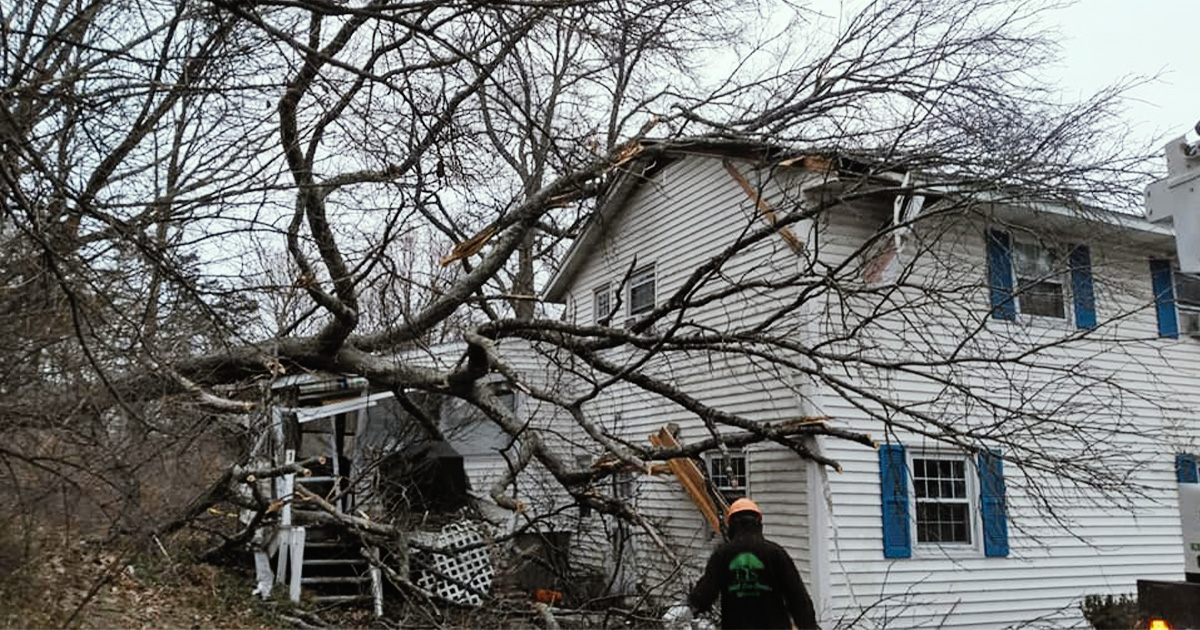
Deciding whether to remove a tree is one of the toughest calls a Hudson Valley homeowner can make. Maybe the old maple is leaning toward your roof. Maybe a massive oak is shading your pool into a swamp. Maybe last winter’s ice storm left a tree looking like it lost a fight.
Whatever the situation, you want answers to three questions: should this tree come down, can I do it myself, and will insurance help pay for it?
This guide covers all three. We’ve been helping homeowners across Ulster, Dutchess, Greene, and Columbia counties make these decisions since 1936, and we’ve distilled what we’ve learned into one comprehensive resource.
Trees Too Close to Your House: When Shade Becomes a Problem
Not every tree near a home is a hazard, but some are quietly causing damage you won’t notice until it’s expensive. Here in the Hudson Valley, our older housing stock (the median construction year in Kingston and Saugerties is 1938), combined with heavy rainfall and clay soils, makes this a bigger concern than in most regions.
How Trees Damage Foundations
A tree close to your home can cause problems in several ways. The canopy traps moisture against the siding and foundation, which prevents natural drying after rain. In areas with poorly draining clay or silt soils, common in the eastern lowlands around Saugerties and Catskill, this moisture lingers for days. Over time, that persistent dampness accelerates freeze-thaw cycles that crack masonry and shift foundations. The Hudson Valley averages around 110 freeze-thaw days per year, so even moderate moisture retention adds up.
Root systems create their own set of problems. Silver maples, willows, and poplars have aggressive roots that can infiltrate foundation cracks and underground plumbing. Even less aggressive species spread roots far beyond their visible canopy, seeking water wherever it collects.
How Close Is Too Close?
The safe distance depends on the tree’s mature size:
| Tree Size | Height | Min. Distance from Home |
| Small | Under 30 feet | 10–15 feet |
| Medium | 30–70 feet | 15–20 feet |
| Large | 70+ feet | 20–40 feet |
These distances help prevent both root intrusion and canopy-related moisture trapping. If your tree is within these ranges and you’re seeing signs like moss or algae along the foundation, mud that never dries near the perimeter, cracks in basement walls, or visible roots in foundation cracks, it may be time to act.
High-Risk Species Near Homes
Some species are especially problematic when planted close to a house. Silver maples, willows, and poplars all have aggressive, shallow root systems that seek out water lines and foundation cracks. Large oaks have enormous canopies and root networks that can dominate a yard. Softwoods like spruce and fir create dense shade with shallow roots. If any of these are within the minimum distances above, removal is usually the smart long-term move, especially on wet clay soil near an older home.
Trees Near Your Pool: Safety, Maintenance, and Comfort
Pools and trees can coexist, but there are several situations where removal makes life significantly easier and safer.
The most obvious concern is safety. Branches overhanging a pool or deck area can break during storms and fall on anyone below. Even healthy-looking limbs can have internal weaknesses that aren’t visible from the ground.
Then there’s maintenance. A tree next to a pool means a constant stream of leaves, twigs, seeds, and pollen in the water. That means clogged filters, more skimming, and higher chemical costs to keep the water balanced. Removing or trimming trees around the pool dramatically cuts down on the daily cleanup.
Temperature is another factor. Excessive shade can lower pool water temperatures enough to make swimming uncomfortable, particularly during the cooler bookend months of the season. Strategically removing one or two trees can extend your usable swim season by weeks.
Finally, tree roots can threaten your pool’s infrastructure. As roots grow, they can infiltrate underground plumbing, crack the pool shell, or heave surrounding deck pavement. By the time you see the damage above ground, the repair bill is already significant.
DIY Tree Removal vs. Hiring a Professional
Once you’ve decided a tree should come down, the next question is whether you can handle it yourself or need to bring in a crew.
When DIY Might Be Okay
A small tree, under about 15 feet tall with a trunk diameter under 6 to 8 inches, may be manageable with a handsaw or small chainsaw if it stands well away from power lines, structures, and other hazards, and there’s plenty of open space for it to fall. You’ll need the right tools (axe, saw, safety gear including helmet, goggles, gloves, and sturdy boots) and enough experience to make proper felling cuts and assess risks like dead limbs or hidden rot.
When You Absolutely Need a Professional
Call a licensed tree company any time the tree is taller than 15 feet, has a large trunk, extensive root system, or a heavy lean. The same applies when the tree is near your home, power lines, roads, driveways, or any structure. Diseased, rotting, or storm-damaged trees are unpredictable and dangerous and they can split, kick back, or fall in unexpected directions.
Professional crews bring equipment that makes the job safer and faster: cranes for trees in tight spaces, ropes and rigging for controlled lowering of heavy limbs, and stump grinding equipment. They also handle the post-removal logistics, such as wood disposal, site cleanup, and stump removal, so your property is ready for whatever comes next.
Hudson Valley Tree Removal Laws and Permits
Before you remove or significantly alter a tree, check your local town or village regulations. Many Hudson Valley municipalities regulate tree removal, even on private property, particularly near roadways where trees serve public-welfare and aesthetic purposes.
Key points to be aware of:
- Private property restrictions: Some towns regulate shade trees or trees near public streets, even if they’re on your land. Removal may require a permit.
- Dead or dangerous trees: Most towns allow immediate removal of clearly hazardous trees, though documentation may still be required.
- Permit applications: Where required, you’ll typically file an application with the town, sometimes with a fee and approval from a planning commission or tree board.
- Financial responsibility: Homeowners are generally responsible for the costs of maintaining or removing regulated trees on or near their property.
To avoid fines or disputes, contact your local planning department before starting work. Or skip the research entirely, and call us at 845-331-6782 and we’ll help you navigate the permit process for your specific town.
Will Insurance Cover Tree Removal?
This is one of the first questions homeowners ask after a tree comes down in a storm. The answer depends on your specific policy, but here’s the general framework.
Homeowners Insurance
Most homeowners policies will cover damage from a fallen tree if two conditions are met. First, the tree fell because of a “covered peril,” an event specifically listed in your policy, typically including ice storms, freezing rain, lightning, and high winds. If the tree fell in calm weather due to rot, age, disease, or neglect, it likely won’t be covered. Second, the damage must be to a “covered structure” named in your policy, such as your home, garage, or fence.
Beyond property damage, many policies also cover the cost of removing the fallen tree itself if it landed on a covered structure or is blocking your driveway or front entrance. However, if a tree falls in your yard and doesn’t hit anything, removal costs typically come out of your pocket.
Car Insurance
If a tree falls on your vehicle, comprehensive auto coverage generally reimburses you for the vehicle damage, again, provided the event was sudden and unexpected rather than caused by a known hazard. Unlike homeowners insurance, car insurance rarely covers the cost of removing the tree from around your vehicle.
The Case for Preventive Removal
Here’s the catch that trips up a lot of homeowners: insurance generally doesn’t cover preventive removal of a tree that hasn’t fallen yet, even if it’s obviously at risk. And if a tree falls due to neglect (rot you should have addressed, a known lean you ignored), your claim may be denied entirely. This is why regular maintenance and proactive removal of hazard trees is a smart financial investment, it’s almost always cheaper than the deductible plus uncovered costs after a disaster.
Why This Matters More in the Hudson Valley
Our region takes a beating every winter. Kingston averages 42 inches of snow per year, Catskill gets 44 inches, and Pine Plains can see over 52 inches. On top of the snow, we get ice storms, heavy rain, and strong winds that stress trees already weakened by pests, disease, and age.
That combination means Hudson Valley homeowners face tree emergencies more often than homeowners in milder climates. The snowfall accumulates on branches, the freeze-thaw cycles weaken wood and root systems, and one windstorm can turn a compromised tree into a property-damage event. Being proactive by evaluating trees before winter, removing obvious hazards, and keeping up with trimming is the best way to avoid emergency costs and insurance headaches.
Quick Decision Framework: Should This Tree Come Down?
If you’re still on the fence, run through these questions:
- Is the tree within the minimum safe distance of your home for its size? (See the table above.)
- Is the foundation showing signs of moisture damage, such as moss, cracks, persistent dampness?
- Are roots visible in foundation cracks, near plumbing, or heaving pavement?
- Is the tree overhanging your pool, deck, driveway, or a walkway where people gather?
- Is it a high-risk species (silver maple, willow, poplar) on wet or clay soil?
- Has the tree lost major limbs in recent storms or shown signs of disease or internal decay?
- Is the tree leaning, especially toward a structure?
If you answered yes to two or more of these, a professional evaluation is strongly recommended. If three or more, removal is likely the safest path forward.
Not Sure? We’ll Help You Decide.
Expert Tree Service has been helping Hudson Valley homeowners make these decisions since 1936. We’ll evaluate your tree, explain your options, and give you an honest recommendation, whether that’s removal, trimming, cabling, or simply leaving it alone.
Call us at 845-331-6782 for a consultation. We’re available 24/7 for emergencies across Ulster County, Dutchess County, Greene County, and Columbia County.