A storm rolls through overnight. You wake up to find a fallen tree across your driveway, or worse, on your roof. It’s a situation Hudson Valley homeowners deal with every year, and how you respond in the first few hours matters.
This guide covers what to do immediately after storm damage, how to assess whether a tree is a safety hazard, what to expect from emergency tree removal, and how to navigate insurance claims. If you need help right now, call Expert Tree Service at 845-331-6782; we are available 24/7.
Step 1: Don’t Touch It
The instinct after a storm is to start cleaning up. Resist it. Fallen trees and broken limbs create hazards that aren’t always obvious:
- Power lines. If a tree or large branch has come down near or on power lines, treat the entire area as energized until Central Hudson or your utility confirms otherwise. Stay at least 30 feet back and call 911 if lines are down in a public area.
- Hanging branches. A tree that’s partially fallen or split may have large branches suspended overhead, called widow-makers, that can drop without warning. Don’t walk under damaged trees.
- Structural damage. If a tree has hit your house, don’t re-enter until you’ve confirmed the roof and walls are stable. A tree’s weight can compromise structural integrity that isn’t visible from the outside.
Assess from a safe distance and call an experienced tree expert before anyone starts tree work.
Step 2: Document Everything Before Cleanup Begins
If you’re planning to file an insurance claim, and for significant storm damage, you should document the scene thoroughly before any tree removal or cleanup begins.
- Photograph the fallen trees, broken limbs, and all property damage from multiple angles
- Note the date and time of the storm
- Don’t move debris or begin repairs until you’ve spoken with your insurance company
Most homeowner’s insurance policies cover storm damage tree removal when the tree has damaged a structure, like your house, garage, fence, or car. If a tree fell in your yard without hitting anything, coverage is less certain and varies by policy. Call your insurance company early and ask specifically what documentation they need before work begins.
Step 3: Assess the Hazard
Not every fallen tree is an emergency, and not every emergency looks dramatic. Here’s how to think about urgency:
Immediate emergency (call now):
- Tree on or through the roof
- Tree blocking the only exit from your property
- Hanging branches over a frequently used area
- Any situation involving power lines
- A hazardous tree visibly leaning toward a structure after high winds
Urgent but not immediate:
- Tree across the driveway with no structural damage
- Large branches down in the yard
- Split trunk on a tree near the house that’s still standing
Can wait for a scheduled appointment:
- Storm damage tree that fell entirely in the yard away from structures
- Minor broken limbs with no fall risk
Calling a tree expert for an assessment is always the right call when you’re unsure. A tree risk assessment from a trained eye takes minutes and tells you definitively whether you’re dealing with a safety hazard.
Step 4: Understand What Emergency Tree Removal Actually Involves
Emergency tree removal is not the same as standard tree removal. The crew is responding to an active hazard, often in wet conditions, sometimes at night, with equipment access complicated by the tree’s position. Here’s what to expect:
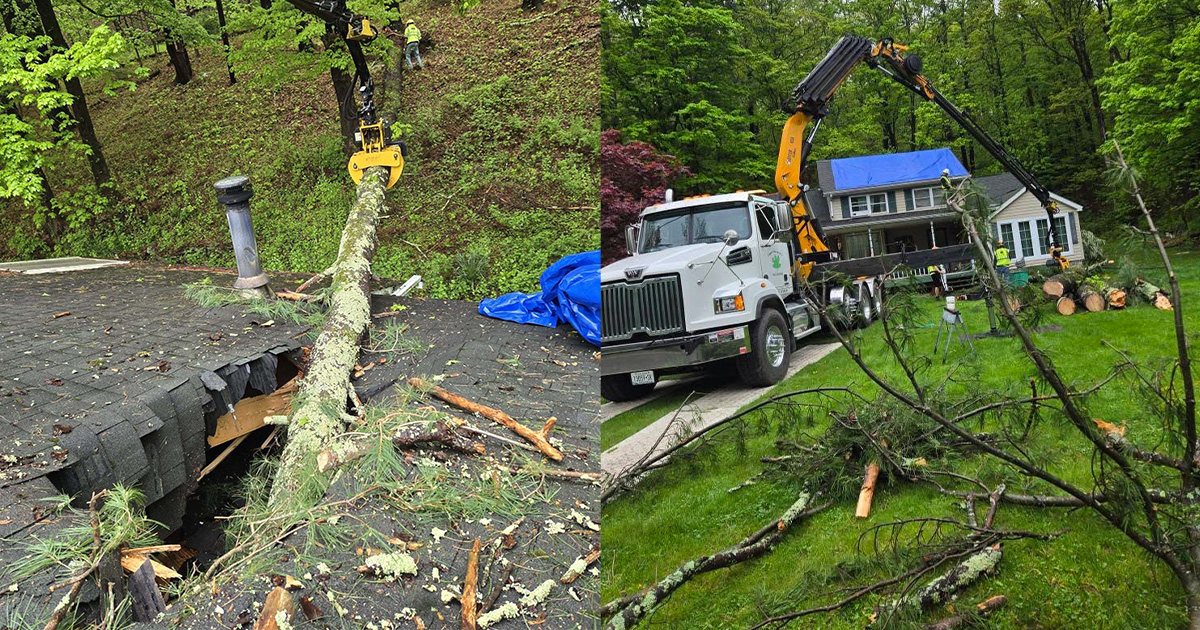
Rigging and sectional removal: When a tree has fallen against a structure, it can’t simply be cut at the base and dropped. Arborists work in sections from the top down, using ropes and rigging to control where each piece lands and prevent further damage to the roof, walls, or surrounding property.
Power line coordination: If the tree is near power lines, the tree service may need to coordinate with your utility before work can begin. This adds time but is non-negotiable for safety.
Stump grinding: Emergency removal typically addresses the tree itself. Stump grinding is usually scheduled as a separate follow-up visit once the immediate hazard is cleared.
Debris removal: A full-service tree removal includes chipping branches and hauling away debris.
Step 5: Think About What Caused It
After the immediate storm damage is cleared, it’s worth understanding why the tree failed. Hudson Valley homeowners deal with a specific set of tree care conditions:
Root rot and internal decay: A tree can look healthy from the outside while its core is compromised. Trees that fail in moderate storms, and not hurricane-force winds, often had internal decay that went undetected. A post-storm inspection of nearby trees by a tree expert can identify similar risks before the next severe weather event.
Structural defects: Tight branch angles, co-dominant stems, and included bark are structural weaknesses that develop over years. Proper pruning earlier in a tree’s life prevents many of the splits and failures that become emergency tree removal calls. If your remaining trees haven’t been assessed in several years, now is a good time.
Hazardous trees near structures: If a fallen tree was close to your house, look at what’s still standing nearby. Power lines, rooflines, and high-traffic areas should be clear of trees with visible defects, deadwood, or signs of disease.
We’ve Served the Hudson Valley Since 1936
Expert Tree Service has been handling emergency tree removal and storm damage cleanup across Ulster, Dutchess, Columbia, and Greene Counties for nearly 90 years. We’re based in Saugerties, which means fast response times throughout the region, and we’re available 24 hours a day, 7 days a week for storm emergencies.
We serve homeowners in Kingston, Poughkeepsie, Rhinebeck, Red Hook, Catskill, New Paltz, Ellenville, Germantown, Clermont, Rosendale, Pawling, and the surrounding areas.
Call 845-331-6782 any time, or fill out our contact form for non-emergency tree service requests.
It depends on your policy and the situation. Most insurance policies cover tree removal when a fallen tree has damaged a covered structure like your home, garage, or fence. If the tree fell without hitting anything, coverage varies. Document everything before cleanup begins and contact your insurance company before work starts.
Expert Tree Service is available 24/7. Response time depends on storm volume after a major weather event affecting the whole region, crews are dispatched based on severity of hazard. Trees on structures and power line situations are prioritized.
It depends on the extent of the damage. A tree that has lost some large branches may be a good candidate for structural pruning and cabling. A tree that has split at the trunk or lost more than half its canopy is generally a removal. A certified arborist can assess the tree and give you an honest recommendation.
Emergency tree removal responds to an active hazard like a tree on a structure, a hanging branch over a walkway, a tree blocking access. It typically costs more than scheduled tree work because of the complexity, conditions, and urgency involved. Regular tree removal is planned in advance and allows for optimal equipment positioning and crew preparation.
Yes. Full debris removal and chipping are part of our tree removal services. We can also coordinate stump grinding as a follow-up visit after the emergency work is complete.
We serve the full Hudson Valley including Kingston, Saugerties, Poughkeepsie, Rhinebeck, Red Hook, Catskill, New Paltz, Ellenville, Germantown, Clermont, Copake, Athens, Pawling, Rosendale, and surrounding communities in Ulster, Dutchess, Columbia, and Greene Counties.