Five hurricanes have hit Volusia County since 2016. Each time, some trees came through and some landed on roofs, fences and power lines. Which was which wasn’t random.
After the 2004 and 2005 hurricane seasons, University of Florida researchers went into 100 neighborhoods and recorded what happened to 18,200 trees. They counted which were still standing, measured how many branches each lost, and sorted the species into four wind-resistance groups. This post ranks 15 Florida natives by that research.
Volusia’s Last Five Hurricanes
| Hurricane | Date | Top gust reported in Volusia County |
|---|---|---|
| Matthew | October 2016 | 94 mph, New Smyrna Beach |
| Irma | September 2017 | 82 mph, New Smyrna Beach |
| Ian | September 2022 | 96 mph, New Smyrna Beach |
| Nicole | November 2022 | 75 mph, New Smyrna Beach |
| Milton | October 2024 | 99 mph, Ponce Inlet |
After Irma, the county reported more than 814,000 cubic yards of storm debris removed. After Milton, county crews and contractors collected more than 347,000 cubic yards from county and private roads. Those totals don’t include the cities.
The Ranking
The wind group comes from UF/IFAS’s list for the Southeastern Coastal Plain. “Still standing” is the share of each species left upright after the hurricanes where researchers counted at least 20 of them.
| # | Tree | UF wind group | Still standing | Mature size (height × spread, feet) | Salt tolerance |
|---|---|---|---|---|---|
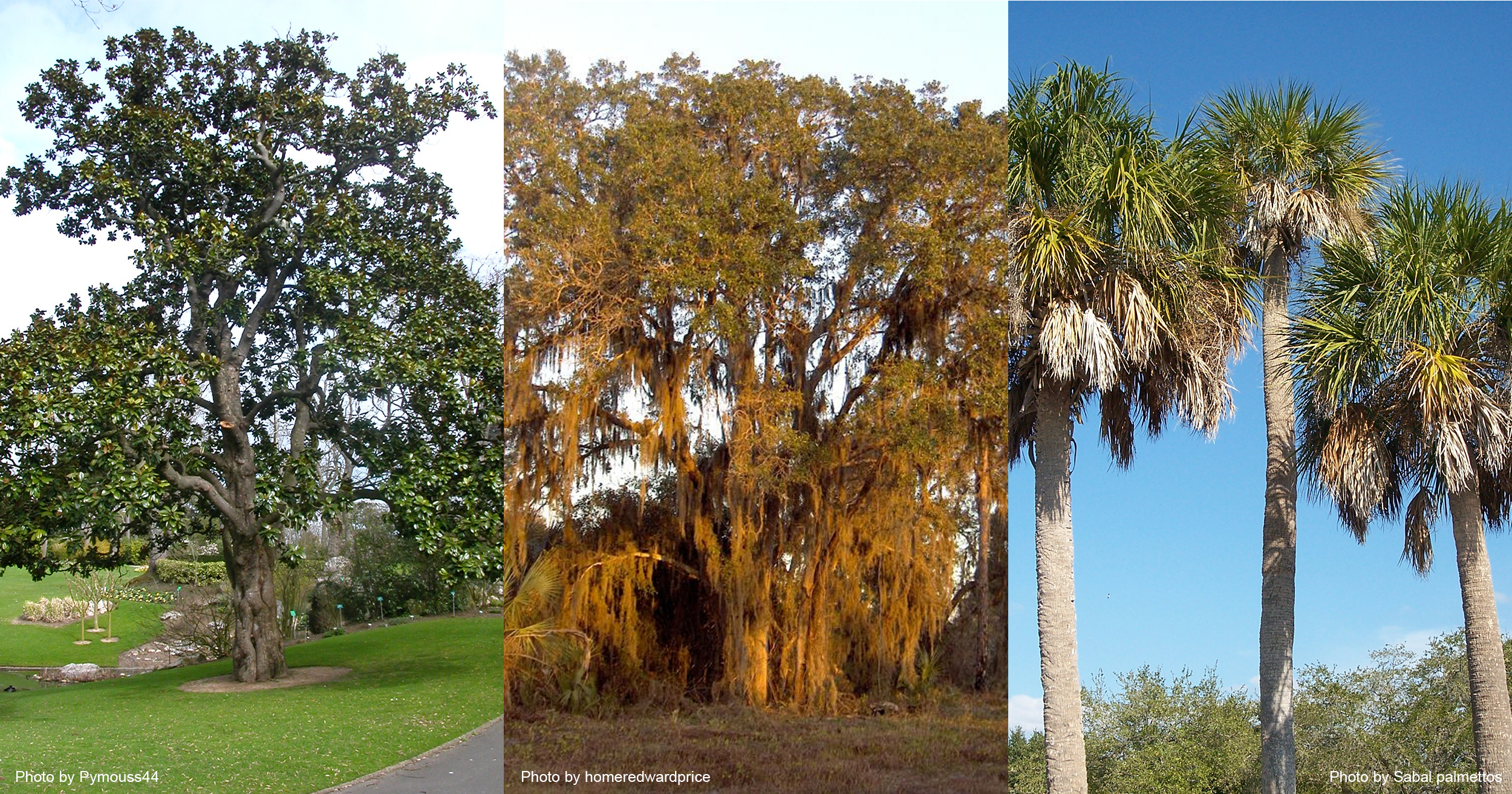
| 1 | Sand live oak | Highest | 94–99% in 4 hurricanes | About 50 tall | Grows on coastal dunes |
| 2 | Cabbage palm | Highest | 80–100% in 6 | 25–60 × 10–15 | High |
| 3 | Live oak | Highest | 78–97% in 6 | 40–80 × 60–120 | High |
| 4 | Southern magnolia | Highest | 92–97% in 3 | 40–80 × 15–40 | High |
| 5 | Bald cypress | Highest | 95% in Charley | 50–80 × 10–35 | Medium |
| 6 | American holly | Highest | 95% in Ivan | 35–50 × 15–25 | Medium |
| 7 | Yaupon holly | Highest | Not counted. 81% of experts rated it high | 15–30 × 6–20 | High |
| 8 | Dahoon holly | Highest | Not counted. 76% of experts rated it high | 20–30 × 15–20 | Medium |
| 9 | Sweetgum | Medium-high | 86–93% in 2 | 40–100 × 40–60 | Medium |
| 10 | Winged elm | Medium-high | Not counted. 53% of experts rated it high | 45–70 × 30–40 | Medium |
| 11 | Wax myrtle | Medium-low | 90% in Ivan | 10–40 × 20–25 | High |
| 12 | Slash pine | Medium-low | 72–96% in 3 | 75–100 × 35–50 | High |
| 13 | Red maple | Medium-low | 76–93% in 2 | 35–80 × 25–35 | Low |
| 14 | Southern red cedar | Lowest | 60–92% in 3 | 30–45 × 20–30 | High |
| 15 | Laurel oak | Lowest | 77–94% in 5 | 60–70 × 35–45 | Low |
Within each group, the order is ours, based on the survival counts. UF/IFAS adds a caution to its own list: “no tree is perfectly wind-proof.”
Standing Isn’t the Whole Story
A tree can stay upright and still lose half its crown. So the researchers ran the numbers again for Hurricane Ivan, a 130 mph storm, counting any tree that lost half or more of its branches as dead.
| Tree | Still standing after Ivan | Standing with most of its branches |
|---|---|---|
| Sand live oak | 99% | 98% |
| Live oak | 91% | 81% |
| Laurel oak | 77% | 66% |
| Southern red cedar | 61% | 46% |
That second column is why laurel oak and southern red cedar sit at the bottom.
The Top of the List
Sand live oak and live oak. Both are in UF’s highest group. Live oak stayed upright in every one of the six hurricanes studied, from 97 percent in Jeanne to 78 percent in the 165 mph winds of Andrew. It needs room. UF/IFAS lists a mature spread of 60 to 120 feet and says it’s not for small lots. Sand live oak is the smaller cousin, at home on dunes and sandy scrub.
Cabbage palm. Florida’s state tree. Ninety-nine percent of the experts UF surveyed rated its wind resistance high, the best score of any tree on the survey.
Southern magnolia and bald cypress. Both rate high for wind. Bald cypress is a wetland tree that also adapts to dry sites.
The hollies. American, yaupon and dahoon holly are all in the highest group, and all three fit yards where a live oak won’t. Dahoon and yaupon top out around 30 feet.
Three That Surprise People
Laurel oak. It’s one of the most common shade trees in Florida yards, and it’s in the lowest group. UF/IFAS puts its life span at 50 to 70 years and says trunks and large branches “often hollow from decay.” In the survey, 57 percent of experts rated its wind resistance low. Four percent rated it high.
Southern red cedar. Often recommended for the coast because it shrugs off salt. It handles salt well and wind badly. Only 60 percent were standing after Opal and 61 percent after Ivan.
Pines. Slash pine often stays up in the storm and dies afterward. Three months after Hurricane Charley, 27 percent of the South Florida slash pines still standing had died, and so had 48 percent of the longleaf pines. UF says pines can die over a period of six months to two years after a windstorm.
Does Native Mean Wind-Proof?
No. In South Florida’s hurricanes, natives did survive better than exotics. In the Coastal Plain, which is the list that covers Volusia’s climate zones, UF found no real difference. After Ivan, 73 percent of natives and 77 percent of exotics were standing. The species matters more than where it comes from, and four of the 15 natives above are in the two lowest groups.
What Else the Research Found
- Trees in groups do better. A group meant five or more trees, each within 10 feet of another. In Ivan, 80 percent of grouped trees survived against 70 percent of trees standing alone. In Jeanne it was 88 percent against 78.
- Roots need room. In Hurricane Georges, trees with more than 75 square feet of rooting space survived at 91 percent. Trees with less than 40 square feet survived at 64 percent.
- Pruning helps. In the survey after Hurricane Andrew, 73 percent of properly pruned trees survived, against 47 percent of unpruned ones. That was South Florida, and “pruned” didn’t mean topped.
- Big old trees lose more. Trees with trunks over 39 inches across lost 30 percent of their branches on average. Trees under 8 inches lost 12 percent.
How Much Room to Give a New Tree
| Tree size at maturity | Soil area it needs | Distance from pavement |
|---|---|---|
| Small (under 30 feet tall) | 10 × 10 feet | 2 feet |
| Medium (under 50 feet tall or wide) | 20 × 20 feet | 6 feet |
| Large (over 50 feet tall or wide) | 30 × 30 feet | 10 feet |
Under power lines, UF/IFAS Extension says a tree planted within 20 feet of an overhead line should mature at no more than 25 feet tall. Tall trees belong more than 50 feet away.
If the Tree Is Already in Your Yard
Most people aren’t choosing a tree. They’re living with the ones that came with the house. UF’s advice for trees in the lowest group is to have over-mature ones inspected and to remove those at high risk of failure. It names laurel oak and water oak.
Expert Tree Service looks at trees across Volusia County before storm season and after it.
Tree trimming and palm pruning
Tree removal
Storm and hurricane cleanup
All Volusia County tree services
Call 386-286-4341 for a free estimate.
Quick Answers
Among the Coastal Plain trees UF/IFAS studied, sand live oak, live oak and cabbage palm had the strongest record across the most storms.
No. Live oak can live for centuries and resists decay. Laurel oak typically lives 50 to 70 years and often hollows as it ages.
UF/IFAS says to allow at least six months for a palm to put out new fronds.